


Descripción
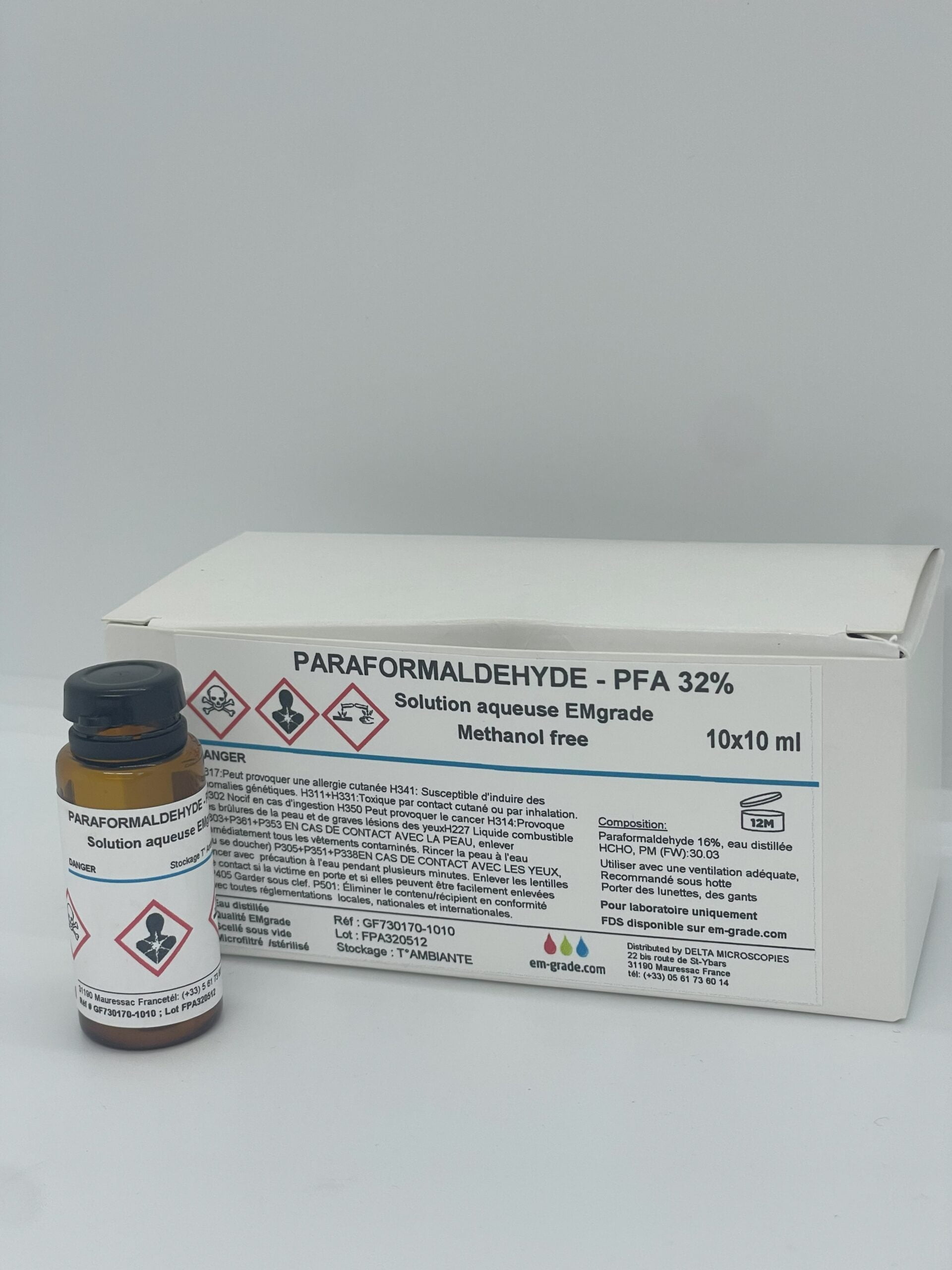
⚗️ Why choose EM-Grade Paraformaldehyde aqueous solution?
- Ready-to-use, always fresh — no overnight prep, no quality drift between experiments. Your results are reproducible from day one, your technicians save time.
- Methanol-free formulation — unlike most PFA solutions on the market, our PFA contains no methanol stabiliser. Critical for immunocytochemistry (no epitope denaturation), membrane lipid preservation, and cryo-EM vitrification protocols.
- 12 months shelf life — even opened — our argon-sealed airless bottle prevents oxidation and polymerisation. An opened bottle lasts as long as a sealed one: 12 months of reliable fixation. Learn more about our airless bottles.
- Six concentrations × six volumes — from 10 mL ampoules for single-use fixation to 1 L bottles for routine histology. You never over-order.
- Custom pH on demand — standard pH is ~4.3 (native acidic pH of formaldehyde in solution). For neutral-pH fixation, our chemists adapt the pH to your protocol (PBS 7.4 — Sorensen 7.2 — cacodylate 7.4 — HEPES — other). Contact us.
- Made in France, eco-responsible — formulated and bottled in our lab near Toulouse, traceable batches, recyclable packaging, shorter supply chain than US/UK alternatives.
- Responsive support — direct line to our chemists Arthur Ferullo and Nacer Benmeradi for any protocol question. Response within 24h.
📋 Technical specifications
| Specification | Value |
|---|---|
| Product name | Paraformaldehyde (PFA) in Aqueous Solution |
| CAS number | 50-00-0 (formaldehyde in solution) |
| Concentrations available | 4%, 8%, 10%, 16%, 20%, 32% |
| Volumes available | 10 mL × 10 (ampoules), 30 mL, 100 mL, 250 mL, 500 mL, 1000 mL |
| Packaging | Argon-sealed airless bottle (sealed ampoule for 10 mL format) |
| pH | ~4.3 (acidic native pH) — custom pH available on request |
| Solvent | Distilled water (methanol-free formulation) |
| Methanol content | None — pure PFA, no stabiliser added |
| Storage | Room temperature, protected from light |
| Shelf life (sealed) | 12 months from manufacturing date |
| Shelf life (opened, airless) | 12 months — same as sealed, thanks to argon airless system |
| Safety | H351 — suspected of causing cancer. See full SDS below. |
| SDS / MSDS | See «SEE TECHNICAL FILE» button above |
| Made in | France |
Note on pH — our PFA aqueous solution has an acidic native pH (~4.3), as is standard for unbuffered formaldehyde solutions in water (consistent with references from Agar Scientific and Carl Roth). For fixation protocols requiring a neutral pH (most TEM/SEM applications), we strongly recommend either (a) ordering the custom pH version adapted to your buffer of choice, or (b) diluting our standard solution in your working buffer on the bench.
🔬 PFA applications in electron microscopy
TEM & SEM fixation
PFA aqueous solution is the first fixative in most double-fixation protocols for transmission and scanning electron microscopy. A 4% PFA solution is the standard for cell monolayer fixation, while 2% PFA + 2.5% glutaraldehyde (Karnovsky-type mix) is the reference for tissue ultrastructure. Read our full guide to the Karnovsky fixative.
Immunochemistry & cryo-EM
For immunogold and immunofluorescence applications where antigen preservation is critical, PFA alone (2–4%) preserves epitope recognition better than glutaraldehyde-based mixtures. For cryo-EM vitrification workflows, the 16% or 32% concentrations can be diluted in your buffer of choice on the bench.
Cell biology & histology
Higher concentrations (8%, 10%) are used for long-term tissue storage before paraffin embedding. The 32% stock is a convenient concentrate for laboratories preparing their own working dilutions.
🧪 How to use — Protocol & best practices
Recommended dilution
The 32% concentrate is intended to be diluted to your working concentration (typically 4%) in your buffer of choice. For ready-to-fix workflows, order the final concentration directly (4%, 8%).
Buffer compatibility & pH
PFA is compatible with PBS, Sorensen phosphate buffer, PHEM, cacodylate, and HEPES. Buffer choice influences cell morphology and antigen preservation — read our guide on choosing the right pH for your fixative buffer and how osmolality affects fixative quality.
Fixation protocol (generic)
- Pre-warm the PFA solution to room temperature.
- Remove culture medium, rinse with PBS (37 °C).
- Apply 4% PFA for 15 minutes at room temperature (cells) or 2–4 hours (thick tissues).
- Rinse 3× with PBS.
- Proceed to post-fixation (glutaraldehyde or osmium tetroxide) or immunostaining.
⚠️ Safety & handling
Paraformaldehyde is classified H351 — suspected of causing cancer (GHS Category 2). Handle under a chemical fume hood with nitrile gloves, lab coat, and safety glasses. Avoid inhalation of vapours and skin contact. Dispose of used solutions as halogen-free organic chemical waste according to your institution’s policy.
Download the full Safety Data Sheet via the «SEE TECHNICAL FILE» button at the top of this page.
❓ Frequently asked questions
What is the difference between paraformaldehyde and formaldehyde?
Paraformaldehyde is the polymerised, solid form of formaldehyde. When dissolved in water with gentle heating, it depolymerises into formaldehyde monomer — the actual fixative agent. Our PFA aqueous solution is already depolymerised and ready to use, so you skip the heating step entirely.
Which buffer should I use with PFA?
The most common buffers are PBS (7.4), Sorensen phosphate, PHEM, and cacodylate. PBS is the default for immunofluorescence; cacodylate preserves ultrastructure better for TEM. See our buffer comparison guide.
Can I dilute the 32% stock to 4%?
Yes. Dilute 1 volume of 32% PFA with 7 volumes of your buffer (e.g., 1 mL PFA 32% + 7 mL PBS = 8 mL PFA 4%). The diluted solution is stable for up to 24 hours at 4°C, but we recommend preparing it just before use.
Is PFA compatible with immunogold labelling?
Yes — PFA alone (2–4%) preserves most epitopes. If you need ultrastructural preservation, a low-percentage glutaraldehyde (0.1–0.5%) can be added, but it will reduce antigenicity for some markers.
How long does an opened PFA bottle last?
Thanks to the argon-sealed airless bottle, an opened bottle remains usable for up to 12 months at room temperature, protected from light — the same shelf life as a sealed bottle. The dispenser prevents air ingress, which is the primary cause of PFA oxidation and polymer drift. This is a key differentiator versus conventional bottles which degrade within weeks of opening.
What is the pH of your PFA solution? Why is it acidic?
Our standard PFA aqueous solution has a native pH of ~4.3, which is the natural pH of unbuffered formaldehyde in water (formaldehyde slowly oxidises to formic acid, lowering the pH). This is consistent with products from Agar Scientific and Carl Roth. For fixation protocols requiring a neutral pH, you can either (a) order our custom pH version adapted to your buffer of choice, or (b) dilute in your working buffer on the bench.
Can you provide PFA with a custom pH?
Yes. Our chemistry team adapts the pH to your protocol (PBS 7.4, Sorensen 7.2, cacodylate, HEPES, or any target between 6.0 and 8.0). Specify your target pH when you order or contact Samia for bulk and recurrent orders.
Is your PFA solution methanol-free?
Yes — our PFA solution is 100% methanol-free. Most commercial PFA solutions contain methanol as a stabiliser (typically 10–15%), which can denature sensitive epitopes, extract membrane lipids, and interfere with cryo-EM vitrification. Our formulation is pure paraformaldehyde dissolved in distilled water under argon, with no additives. This makes it the preferred choice for immunocytochemistry, lipid-sensitive applications, and cryo-EM workflows.